On Sunday, 5 January 2025, Professor František Šmahel, the prominent Czech medievalist passed away at the age of 90. We mourn in his person not only one of the greatest historians of his generation, but also a close friend of the Department of Medieval Studies at the CEU.
While we had our preparatory year, in 1992-93, he participated at our first big international conference on 23-27 April, 1993, on “Ethnicity – concepts and conflicts in medieval Central Europe”, co-organized with Ernest Gellner. He accepted to serve on the Academic Board of our new department, and in March 1994 he came to Budapest to our board meeting chaired by Jacques Le Goff, a good friend of his. At that point we knew three things about him: in the 1960s he became one of the best Czech experts on Hussitism; he was dismissed from the Historical Institute in 1974 for political reasons and he had to work for four years as a tram-driver in Prague; after 1989, he returned to the reconstituted Historical Institute, became its director. While we could enjoy his cooperation for reviewing the theses of students working on Czech themes, we were watching with growing admiration the unfolding of his academic achievements.
After two terms as director of the Historical Institute, in 1998 he founded the Centre for Medieval Studies, a joint initiative of the Academy of Sciences of the Czech Republic and Charles University, where he served as director for many more years. In 2002 he published his mighty three volume monograph Die Hussitische Revolution. His 20 essential studies on The Charles University in the Middle Ages were put together in a volume in 2007. His close contacts with the Annales colleagues were honored by a spectacular monograph on The Parisian Summit, 1377–78. Emperor Charles IV and King Charles V of France published in English in 2014. And this is only a small part of his oeuvre. For the last three decades he was the uncontested doyen of Czech historians, helping, supporting the rise of a new generation of younger colleagues as medievalists, and investing much energy for situating the results of Czech historical research in an international context. His passing marks an irreplaceable loss to the academic community of in the Czech Republic, in Central Europe and in the broader world.
Written by Gábor Klaniczay
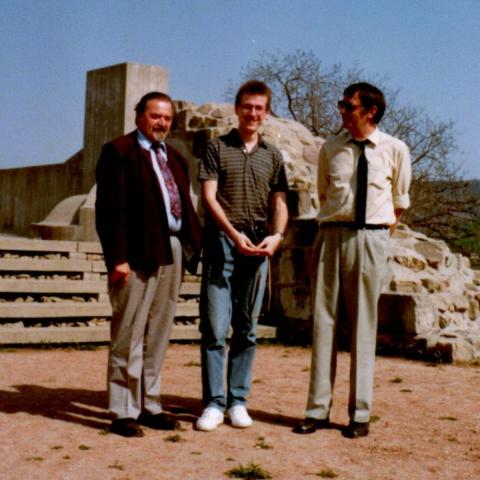
Photo: František Smahel (left) with MA student Pawel Kras and Dušan Třeštík, in 1993, at the CEU excursion in Visegrád