Stories from our Sources - Part 1

July 22, 2025
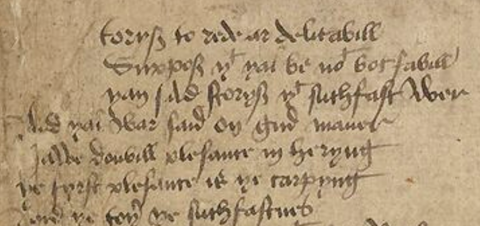
Source: Edinburgh, National Library of Scotland, Adv.MS.19.2.2 (i), Manuscript of 'The Brus' of John Barbour (manuscript date: 1489).


Storys to rede ar delitabill,
Suppos that thai be nocht bot fabill:
Than suld storys that suthfast wer,
And thai war said on gud maner,
Have doubill plesance in heryng.


(Stories to read are delectable,
Supposing that they be nothing but fables,
Then should stories that are true,
And that are told in a good manner
Have double pleasure in hearing.)
 
This text comes from a fourteenth-century Old Scots story of Robert Bruce (transcribed from Adv.MS.19.2.2 (i)), and speaks to the delight found in true stories as told in fourteenth-century Scotland. Telling stories helps humans to make sense of the world, and stories and the truths in whatever form contained in them provide much of the material for the study of the historical sciences.
  
Across chronological periods and geographical regions, the faculty and students in our department study narratives in their myriad forms. For example, the image below was dsicovered by PhD candidate Julia Boechat as part of her doctoral research. She took the picture while on a fellowship at the University of Michigan, researching Soviet book pirates. It gives a snippet of a story about pirating Dr Zhivago.
  
Pirating Dr Zhivago
  
Closer to Vienna, but chronologically further back in time, Prof. Katalin Szende found the letter below where Nicholas of Rum, son of a middling noble family from Western Hungary, asks his parents to send him his cloak, money and a cow because he loves milk. It can be dated to 5.August 1451. The text reads, as transcribed and translated by Prof. Szende,
  

1. Filiali salutatione premissa. Sciemus nos esse sanos et recenter studere, qua quidem a v[estra] p[aternitate] semper

2. audire optamus v[estre] presentibus supplicamus p[aternitati] quatenus palia nostra cum expensis mittatis nobis cicius

3. scitis autem quod lac valde diligimus ideo nobis unam vaccam mittatis, quam eciam promissimus hospiti

4. nostro et petimus non mittatis nos in mendacio. Si super vixerimus donante deo pro una vacca

5. plures dabimus [ut Nicolaus ferebit v] Datum Jaurini in festo Maria de nive anno Domini

6. Mo CCCCo Quinquagesimo primo. Scripsi manu propria Nicolaus de Rum filius vester

7. Et ego Ladislaus de Rwm filius vester ut Nicolaus scribit vobis sic et ego supplico nobis

8. Dare predicta quia oculum doleo plus non scripsi


(We send our filial greetings. You should know that we are healthy and studying, and we would always like to hear the same from you, Father. We implore you to send us our cloaks and the money as soon as possible. Since you know how much we love milk, please also send us a cow, we have promised it our host. We ask that you do not leave us to lie. If we survive, God willing, we will give you many cows in return for one. Written in Győr on the Feast of St Mary of the Snows, in the 1451st year of the Lord. Written in my own hand, Nicholas of Rum, your son.

Me too, Ladislas of Rum, your son, just as Nicholas writes to you, I also ask you to give us the aforementioned items. I haven't written more because my eyes are hurting.)


National Archives of Hungary, MNL OL DL 49999


Congratulations if you can read and translate the text, but if not, we have our source language instructors (in Latin, Greek, Armenian, Arabic, Syriac...) to help researchers understand their sources, whether written on paper, parchment or stone!